Archive
The Nine Essences of Hsing-I
Once you have the 6 harmonies, and 8 methods figured out, you need to move onto the 9 essences in Hsing-I. The nine essences are as follows:
Body:
Should be straight. never leaning in any direction.
Shoulder:
Should be dropped downward. It is thorough the shoulders that the strength is transferred to your hands.
Arms:
The lead arm is stretched forward, the rear is close to the ribs.
Hands:
The rear hand should be at the Tan Tien. The Lead held Chest level. The palms should face downward, with even strength.
Fingers:
Are separated and shaped like hooks. The index finger and thumb form a crescent. There must be strength in the fingers.
Legs:
Are kept straight, yet slightly bowed like a chicken.
Feet:
The toes point forward, the rear foot points at a 45 degree angle. The toes must be firm.
Tongue:
The tongue is rolled and touches the roof of the mouth. Chi can then sink to the tan tien when the eyes are lowered.
Hips:
The hip tilt slightly forward so that chi moves to the limbs.
Escaping Patterns Using the Octagon
While Most Martial Arts are by nature very aggressive (including most Kempo systems), and look to engage the opponent, there are a few that appear not to be on the surface. For example practitioners of Kosho Shorei Ryu Kempo believe that the highest level of self defense, is to have no contact with your opponent. In true self defense they believe not only should you not be harmed, but neither should your attacker. Therefore the approach is not to engage if possible. They accomplish this by using escaping, and evading techniques.
Kosho is very much about preparatory arts, timing, and positioning. So to understand escaping patterns please read my posts on eye training, and positioning/ octagon Theory, etc.. You need to understand those things first.
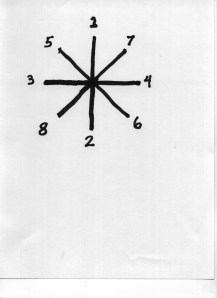
This is one of many escaping patterns, that practitioners practice. To understand how it works think of yourself as starting in the center of the octagon. You then move to each of the eight directions and back to center in order. You can continue the pattern as long as necessary.
Kosho folks always move twice. The first move is intended to put them at a 90 degree angle on their opponent, the second move can do the same, or be used to go through the opponent. For the purposes of escaping you would always be looking to end up 90 degrees on your opponent or possibly behind him. They always move twice because they assume there attacker will attack with all their weapons. Two arms means two punches. So for example the first move would be to position 1, and then move back to where they started. The next moves would be to position 2, then back to center, etc..
Now if you had an attacker start at position 7 or 4 and attacks you in the center, you could move to position 1 ( I used those two directions because moving to direction 1 would be appropriate only with the right combination of eye training and distance). Assuming the attacker continues his attack following you to where you move, you know where is is going to move one move before he does. This allows you too always escape, and end up at a 90 degree angle to your opponent. If he doesn’t follow you in the expected manor and you move, you’ll still just end up further away from each other. In this case neither of you would be harmed again.
If you determine that striking is necessary, by knowing where you’re opponent will move next. If you put your strike out on his line of travel, he will run into the strike adding his power, and momentum to your power on the strike. You will also catch him in transition this way, compounding the damage done.

Methods of Attacking
In reality, whether it is an army, an individual in a bar, or on the street. The most common, and most successful attack is the surprise attack. Let’s face it the hardest attack to defend is one you don’t know is coming. You need to understand that fighting is about winning and destroying your your enemy. You also want to reduce your chances of injury, or losing. Anyone that doesn’t have this mind set (or is at least aware of it), doesn’t survive long in the real world. If anyone thinks that cowboys actually went out in the street at high noon and faced off in a fair fight, they would be wrong.
Examples of armies using this approach would be the Japanese attack on Pearl Harbor, the US attacking Iraq. In the latter case even if a declaration of war happens first, you don’t warn the enemy where and when you’re going to attack them. Think of sentry removal techniques as part of an operation. You sneak up on, and kill the sentry before they know you’re their. I can’t think of any military operation in history where they didn’t try to use the element of surprise in their attack if it was possible.
The police certainly use the same approach when they go to arrest someone. Surprise, using overwhelming force are the only ways they attack people they are trying to arrest. I’ve never heard of any cop since the invention of the FBI, and J. Edgar Hoover who warned people, fought one-on- one, or used anything resembling a fair fight. At least not by choice.
Individuals using this approach would be said to sucker punch their opponent. While in many cases they just come up and strike, in other cases they come up from behind and attack, in other cases there is a verbal confrontation first. As a general rule in the last case once words have been exchanged, and one person thinks the issue is resolved (The other person wants them to think it is resolved). If one person makes the mistake of turning and taking their eyes off the other guy, before they have backed off out of reach, they are easily attacked. These attacks are extremely common. In my experience all of these attacks are far more common then two guys facing off after a verbal exchange, going outside and engaging in mutual combat.
Moral and ethical issues aside Martial Artists/ Martial Arts Schools don’t teach the above approaches for many reasons. First we are generally teaching civilians. Civilians are subject to the rule of law. Governments/ Current Societies don’t tolerate their citizens going around attacking each other. Win lose or draw, if you use the above approaches you could end up in jail and/or civil court with a lawsuit. I will say though, that anyone willing to engage you in a fight isn’t particularly concerned about the law at that point.
Sometimes people are warned before the attack, and have time to prepare. This is true of armies as well as individuals. With two armies, or two individuals lined up facing each other with all weapons ready, and out of each others reach, successful attacking with minimal risk can be a challenge. To attack you have to cross the distance between yourself, and your enemy. This puts you in transition, and makes you vulnerable.
If martial arts is about anything, it is about deception, and being able to predict your opponents reactions. With that in mind the first two things I want to talk about are fakes and feints.
A fake is something that you do, to make them think you’re doing something. Examples of this could be a head fake, to make them think your moving in a direction, it could be a look, or a sound. You are looking for a reaction from your opponent that you can capitalize on.
A feint is something you do that they must defend against. The idea with a feint is to attack a target that they have to move their defenses to protect against, which exposes another opening for you to attack. The feint doesn’t have to be particularly strong, it just has to make them defend. For example if I really wanted to hit them in the head I might feint at the legs or midsection. As they drop their hands to defend the feint, I hit my intended target. Their are many variations of this, both for individuals, and for armies.
Another benefit of using a fake or feint, is that it can tell you what your opponents subconscious tendency is for defense. If you can predict how your opponent will react to an attack, you can plan the right type of attack to be successful. This is especially helpful in sport competition.
For example if you throw a fake/feint a time or so, and every time your opponent charges you up the middle, or zig-zags to where you were, jamming/attacking you as his counter to your technique, it tells you how and where to hit him. In this instance you would throw the fake/feint and immediately step back at an angle to one side or the other, while throwing you real technique to the spot you just vacated, knowing your opponent is going to occupy it. He’ll run right into the technique, adding to your power.
If on the other hand every time you feint/fake he holds his ground looking to block and counter, your approach to attacking must be different. You don’t want to come straight up the middle because you’d be playing into his strength. Two methods of closing the gap would be to use an angular attack, or a broken rhythm attack.
Angular attacks are just that, you want to set him up so that your attack comes in from an angle, and you aren’t directly in front of him.
Broken rhythm attacks make use of timing, and syncopation. People all have two arms and two legs. So they move in a rhythm. One and Two, and One and Two, etc.. So the idea behind a broken rhythm attack is to set up a rhythm, and then catch them on the half beat with your attack.
Now if you notice that every time you throw a feint/fake your opponent backs off or runs away, you need a different approach. In this case you need to charge straight up the middle until you overwhelm them.
Another approach to minimize your risk, and improve your chances of success is to catch them in transition. Catching someone in transition is a very good method of closing the gap. Catching them in transition gives you a split second advantage during your attack where they have to adjust before they can counter. You can use any kind of transition.
For example if you are lined up in front of your opponent move to either the left or right a step. Your opponent will step to adjust, because they will feel uncomfortable not facing you. Move a few times and watch as they move to keep facing you. Then move again, and quickly attack while they are trying to adjust their position. They will need to finish setting before they can defend. this gives you an edge on your attack.
You can use virtually any kind of transition. You can use their breathing. Time it so when they exhale you attack. They will have to inhale first to move with power. You could use the blinking of their eye. I really like guys that bounce up an down, mimicking a boxer. As they bounce and are going up off their feet into the air, they can’t move until they come back down and their feet are on the ground. Any form of movement, including thoughts are transitions that can give you a split second before they can effectively defend.
There are other forms of attacks, but you can and should combine as many of the above methods of attack as you can. For example combing an angular attack with catching someone in transition is better then using just one or the other method.
Now here is my disclaimer I do not advocate attacking anyone for any reason other then in a sport competition following the established rules of that competition. With that said I think there is a lot to think about on the topic.
Conditioning and Resistance Training
Martial Arts practitioners, all have different opinions on this topic. However as a general rule. every teacher I’ve had, has said not to weight lift/Body Build. This includes external, as well as internal martial artists. Yet to a man they all do some form of resistance training.
I think the reason not to lift weights is that weight lifting/ Body building, focus on isolating muscles to develop maximum growth, and sculpt the body for appearances sake. This is not the best for functionality. What you need is for everything to work together in a synergistic manor. Not to mention that while body building you are constantly tearing down the body, and each time it recovers strength and coordination change a bit. I also noticed while lifting in this manor, while I felt a lot stronger, I was also a bit slower. You certainly need to spend more time stretching to keep from tightening up, or becoming muscle bound.
Of course being hard headed I’ve had to test this theory out myself in my youth. I used to weight lift/body build through High School. I went into the military after High School. My first duty station was Japan, where I learned judo. While in Japan I did very little weight training. Judo classes were two hours long. The first half hour was calisthenics, stretching, and break falls. The second half hour was Newaza (grappling techniques). This was basically paring off and wrestling, switching partners every so often. The second hour was all tachiwaza (standing techniques) we spent the first half hour doing uchikome (fitting in for practice throws, or working on a new throw). The last half hour was randori (free sparring standing). I believe I was in the best shape of my life then. On days not in class I ran3-5 miles, did my push-ups and sit-ups, and trained practice throws using a bicycle inner tube.
In 80 I PCS’d to Germany. I had been given a letter of introduction to Franz Fisher by the Kodokan, to help me go train there. Unfortunately I was stationed on a one acre site on a mountain top. I had a six mile walk to the bottom, where I could get a train to take into Frankfurt. So I spent a lot of time on the mountain lifting weights, and training with another guy that was a TKD Black Belt (we were teaching each other). Anyway after about a year, I managed to get to town to train. I thought I was going to be much better since I was a lot bigger, and stronger then before. Boy was I wrong. The warm-ups about killed me for a few weeks, then I was slow, stiff, and my timing was off. that took a few months to fix. Another guy in the class was also body building, and practicing karate. The instructor was always trying to talk him into giving up the weights, since he was displaying the same speed, timing issues, etc..
After I got back to the states I started training Judo twice a week with Charlie Hooks in northern Indiana, and training Juko Ryu Aiki Jujitsu with Randy Harvell six days a week. Randy had a full nautilus machine gym. We did circuit training three times a week, which did work well, and help our progress. We did high reps, and low sets.
Later I moved and learned/taught a couple different kempo systems. I tried to keep the same approach to conditioning, but if you couldn’t lift doing exercises like push-ups, and sit-ups, anything using your own body weight worked well.
When I started training the internal systems, I notice a different attitude about conditioning.
My first Internal instructor was Wai Lun Choi in Chicago. His approach to training was to do push-ups, sit-ups, leg-lifts, and stretching. The only weight training he did was to use a dumbbell, and he only did a few exercises which simulated things like throwing a hook punch. His belief was that you should only do exercises like this that developed power for a specific martial application.
My Next teacher was Jim McNeil. He also did push-ups, sit-ups, leg-lifts, hand conditioning exercises, and Shih Shui which you swing weights with. The beater that I have for use as part of your training weighs in at just under 5 pounds. Swinging that hundreds of times with each hand is a bit of exercise in itself. We also used to start each morning off with a 1-3 mile run depending on how folks felt that day.
I next started training Taijiquan. The Taiji folks leave me scratching my head the most on the subject of conditioning. They seem to be the most set against physical conditioning, out side of doing their basics, and forms. I was at a seminar, and a couple of us were stretching a little, one guy did a few push-ups before the class started. The Master running the seminar came up to us, and told us not to do that stuff, we should loosen up by only doing our jibengong. Now of course this group does do some resistance training with rubberbands/Bungee cords, but seem to not think of it as a conditioning exercise. The mind set seems to be against anything that isn’t taiji, because physical conditioning supposedly won’t help your taiji. While I can understand there is some truth to that on some level, purposely avoiding normal exercise doesn’t make sense to me.
Here are my reasons for that. First I think that the approach to not waste time on exercise, and devote your time to fundamentals, and your training worked very well up through the 1800’s. This is because people did manual labor all day. They were in great shape, and didn’t eat the junk food we get in the modern western world. For example the Chen villagers were farmers. I don’t know about you, but I grew up around farmers, and they were the strongest people I knew. Most of the people I see drawn to taiji today have desk jobs. The most exercise they get during the day is typing on a keyboard. So we’re certainly not talking about the same animal, as far as practitioners go.
Another reason I think you need some type of resistance training is that, as we age we lose muscle mass, and bone density. It becomes a bigger problem the older we get. The speed with which we lose muscle mass and bone density increases significantly over the age of 50. While losing muscle mass we tend to replace it with fat. So we might not really notice this slow process, as quickly as we should. As you loss muscle mass and replace it with fat, your metabolism slows down. You may stay about the same weight. This turns into a vicious downward spiral. So add some resistance training in, and some cardio. To me this is common sense.
I tend to change up what, and how I do things from time to time. Right now I’m using kettlebells a few times a week, along with a few push-ups, and hand conditioning. I want to slow down the deterioration as much, and as long as I can. I certainly don’t want to have a heart attack, shoveling snow, or pushing a car out of it, because I refused to take basic care of my health.
Should You Only Learn One System, a.k.a. To Know Your Own Art, You Must Know All Others
We’ve all heard of that unbeatable master, that only ever learned one art. They are few and far between, not to mention long gone from this world. All through history the greatest fighters have all learned more then one system. If anyone does their research, I believe it will bare this out.
I certainly think you need a primary system which you focus on, but need training in other systems to augment it. Back in the 70’s when I started my training, the approach many of us took, was to learn a grappling art, striking art, and a weapons art at a minimum to consider yourself complete. Different folks might add in a locking art, a kicking centric, and a hand centric system as well, or do them as subsets of each section. Weapons system of choice could be traditional martial arts weapons, as well as modern firearms. I think you need both. After all men/warriors fight with weapons, and only fight without when they don’t have one, can’t get away with using one, or just find them inconvenient for the circumstances.
The approach I was told, and believe to be best was to get to at least Black Belt level in an art, before adding another system. Many people don’t have the patience to do this, and are convinced to try systems that claim to have taken the best parts of many systems and combined them in a synergistic manor. Many arts have been created using this concept. In some cases it could be true, or at least true for the founder of the system.
Then again if your a student of this system, how could you ever have the depth of understanding the founder supposedly did, without the complete training he did? Then again what if the founder of the system, didn’t really have the depth of knowledge in each/or any of the systems he claimed to be incorporating into his new system? You could end up going down a misguided path, and never really learn what you thought you did.
Of course from an instructors view point, you want a student to empty his cup and only train what you teach. My experience with that has been that students that are trying to train in multiple schools/systems at once tend not to make progress as quickly, if at all. At least without getting to a Black Belt level in one, before beginning the other. In any case the instructor will always feel that they have so much more to teach the student, and if they would only focus on learning what they are trying to teach, they’d make much more progress. I would certainly not try to learn more then two new systems at any time.
I took over an existing Kempo school as owner/instructor in 91. The previous owners never taught sparring, because they didn’t know how, and couldn’t do it themselves. I felt that sparring was a necessary part of training. Many of the students wanted to go compete in open tournaments. They lacked the tools when I took over, and had limited skills. My first approach to teaching them how to spar was to one step, two step sparring drills, etc.. Most of their previous training was all hand technique, though during basics in each class they threw as many kicks as they did punches. While trying to teach them sparring techniques, I found that none of them really could kick. So I tried to teach them strategies/techniques they could use against an accomplished kicker with their existing skill sets.
After months of training folks this way, they just never seemed to get it. So I changed my approach. I started teaching them to kick like a Tae Kwon Do practitioner. Once they developed better kicking basics, I then moved them on to” Bill Wallace “style kicking routines, and strategies. Later I taught them kicking methods ” Bennie the Jet” taught. I found that once they actually became proficient at kicking and truly understood, they could now learn to counter it. When they could kick better, they not only made a better/more realistic Uke (attacker) during practice, but when we went back to the techniques and drills I had originally taught, they could understand and do them.
After that I took the same approach to everything else. If I was teaching knife defense, I would teach them some knife fighting first. I would go through some fundamental Philippine, Indonesian, and/or Japanese knife techniques/drills with them for a some time, before teaching empty hand defense against a knife. At least with this approach they had a realistic idea of what they were up against. I’m sure we’re all seen many a McDojo teaching techniques of question. Some teach techniques building false self-confidence that will get their students killed, should they ever try to use them against a trained attacker. When teaching to defend against grapplers, I taught some basic Judo, etc..
Today MMA could be considered an evolution of the same approach. I say throw in a weapon system at some point to be complete. There is one other thing to consider, and that would be internal styles and external styles.
I personally believe you need to start with external systems first. There will be a time when transitioning, or at least learning an internal system will need to happen. This is for many reasons. One is continued learning to deeper levels of understanding of how the body can be used, once you have attained the level of knowledge/proficiency you can with your external systems of choice. Another reason is that we all age. As we age our bodies deteriorate. The internal styles rely far less on strength, quickness, and size. You can continue to get better in an internal system into old age. Not only that but while training external styles you see a tendency for injuries over time that accumulate. People tend to modify their technique around their old injuries. The internal systems tend to help you heal your old injuries, and improve you health.
I train several systems religiously today, and still go play with others from time to time, because I like them, and they are fun. Each of us have to make our own decisions on what and how to train. Keep the things I’ve mentioned in mind when making your own decisions. After all it is a life long journey, and there are many paths to the top of the mountain.
You Should Always Attack High and Low Together
This is a pretty common concept amongst martial artists. Let’s face it, if your being attacked in more then one place at a time, it is harder to defend then just a single attack. Untrained fighters just aren’t aware at all, and are much more vulnerable to this approach. If they see, and defend one, the other attack will most likely succeed.
There is a concept in Kempo known as walking techniques. The idea with it is that as you move/close with your opponent you put your feet in close to your opponents feet/leg on the first move. There will of course be subsequent movements (at least a second move, you disrupt them on the second move). Once you close follow the previous methods I’ve talked about for positioning, skeletal freezing, timing, etc. if you put your foot very close or on top of the opponents foot, it allows you to control them with your leg as they try to move again. Again you can stop them from moving, take them off their feet, or break things, as they try to make their second move.
Kicking the leg as they try to move, or sweeping them as they move, works well if you want to be more aggressive then just stopping their rotation. Of course you’re still doing everything you should with your upper body attack. You need to learn these different principles, ingrain them until they become unconscious things for you. You keep adding in principles this way. It is like layers of an onion.
Of course this isn’t the only method or system. If you have seen Chen Taijiquan practioners do push hands, you will see them with opposite legs forward, working sensitivity with their legs. While doing push hands they are also pushing with their legs, and will take advantage of an opening either high or low, whichever presents itself.
Other approaches can appear to be more aggressive. For example many systems, most Kempo systems included will fight from a further distance, and intend to immediately resolve the conflict, on contact through the fist move, or flow of moves. Though you need to hit which ever target presents itself, as a general rule it is preferable to hit with the hands, then the feet/legs. The reason for this is that if you kick them on your way in they may not be in reach for your hand/arm attack.
One of the key things I think you need to do to use this approach, is to unbalance your opponent on contact. You want to break his balance and set him in place with your hands, exposing the leg nicely stretched out, locked in place and ready to attack.
If you have ever seen Liu Ho Pa Fa being performed with that 30 degree lean they do, it is perfect for this. They come in from an angle, break the opponents balance, set and stretch out the opponent. Then they follow up. I look at it like using you hands similarly to sticking a fork in a piece of steak to hold it in place, while you use your legs, like a knife to cut off the piece you want.
There are lots of variations on this theme, but you need to think three dimensionally, not two dimensionally.
Preventing your opponent from moving by Structural Freezing
This is a concept that I believe to be of great value to external stylists. Especially once you’ve made contact with your opponent. It has real world practical applications. Especially when trying to stop a situation from escalating, or to give you time to set up your strike. This is a Kempo theory. Touch and sensitivity are important in Kempo, as they are in Chinese Internal Arts.
Structural Freezing, a.k.a. Skeletal Freezing is a method of controlling your opponents ability to move.
As a general rule being directly behind your opponent is the best place to be, but it isn’t always practical to get there. In that case being at the ninety degree angle (or greater), is a good choice.
So the idea with structural freezing is that if you’re at the 90 degree angle on your opponent, he will have to rotate to face you to cause serious harm.
For example if your opponent throws a right punch at you, and you move to the appropriate angle to end up on his right side at 90 degrees (Of course avoiding his strike if possible, or blocking as needed, as you move). From this position your opponent will have to turn to face you, to hit you with his left hand (other hand). In order to do that one side of his body (in this case his right side) will have to retract (rotate away from you). As he tries to hit with his left hand (this is the protracting side, which must rotate toward you). His focus and energy/power/strength will be on the protracting side (the side he is trying to hit you with).
He must maintain structural integrity as he moves (skeletal alignment). If you can disrupt his structure as he moves, you can prevent him from moving at all.
The easiest way is to disrupt the side closest to you, which will have a retracting side if he rotates to face you. Most people focus on the side they are rotating at you to hit you with, and aren’t very aware of the retracting side.
So to stop the side from rotating away from you. First allow the rotation to begin, then suddenly make the retracting side stop, or move in another direction. Forcing a change in direction, or stopping the intended rotation of the retracting joint, or part of the body will disrupt the opponents structure. Remember if you stop the retracting side from moving in the intended manor, you stop the protracting side from moving in the intended manor.
An example would be the opponent throws a right hand at you, you step up on his right as you avoid/intercept/block the strike. You keep your hand on his shoulder as you end up at 90 degrees. As he tries to follow up with his next strike, which would most likely be with his retracted/left hand, he’ll step to face you rotating the right back, as he hits with his left. With your hand on his shoulder feel the shoulder begin its retraction, once it starts, push the shoulder in another direction such as back where it started. You just need to stop the retraction from happening. The harder he punches the more violently you’ll shake him in place (Actually he’ll shake himself) and stop his motion. I used the shoulder as an example, but it could be any joint, or spot on the retracting side of the body. Hips, knees, etc. work really well.
Of course he may not rotate in the direction you think. If he rotates the other direction to for example throw a spinning back fist you need to be able to deal with that. Of course the same rules apply, there will still be a retracting, and protracting side. You could just slide the hand to the other side of the shoulder to stop the retraction. You could also touch with both hands One on the elbow, and one on the shoulder. This would allow you to easily stop the rotation in either direction. Of course you could use one hand, and a leg or foot to control the lower part of the body. This leads me into another topic which I’ll discuss later. Attaching high and low together.
There are many ways to apply this concept. I’ve just given a fundamental explanation, and example. Go play with it, and experiment.
Six Harmonies
When I first started learning internal systems from a legitimate master of internal systems, one of the first and most significant things taught was the Six Harmonies.
A major difference in internal systems, and external systems is the emphasis on “Everything starts together, and everything stops together”. It is a common thing constantly repeated with most internal martial arts. This includes Liu Ho Pa Fa, Hsing-I, Bagua, most styles of Taiji, etc.. Once you’ve learned proper structure/alignment you need to learn how to move.
There are six External Harmonies, and six Internal Harmonies.
External Six Harmonies:
Shoulder/ Hip
The shoulder and hip move together. They start and stop together. the alignment is right shoulder and left hip, left shoulder and right hip.
Elbow/Knee
The same relationships exist between the elbow and knee, as the shoulder and hip. The elbows should never extend past the knees.
Hand/Foot
The same relationships exist between the hands and feet, as the shoulder and hip. If any of these six are moving, all should be moving. If one is not moving, none should be moving. Keep in mind the proper relationships.
Internal Six Harmonies:
Heart/Mind
If you want to kill the mind must turn cold.
Mind/Chi
Chi is directed anywhere in the body by the mind.
Chi/Strength
The muscles and bones join together to produce power.
These principles work with other principles to produce greater power. Each teacher/system may manifest the six harmonies with their own flavor. You must have a qualified teacher to truly learn them.
The Eight Fundamentals of Hsing-I
In order to learn any of the internal systems, there are certain fundamentals that must be learned. Hsing-I starts off with the eight fundamentals. I WANT TO BE VERY CLEAR , EVEN HEARING FUNDAMENTALS/PRINCIPLES, IT IS IMPOSSIBLE TO TRULY LEARN THE INTERNAL SYSTEMS WITHOUT A QUALIFIED TEACHER. It is possible to improve what you have, but you will never get a true understanding, or get to a high level without the right teacher. Some things are generally true of external systems as well as internal systems. The amount of emphasis is different.
The three press ups:
1)The Head.
1a) The head must lift up. As a general rule I would think of being pulled up by a rope/string from the crown of your head. There is a very different sensation by imagining being pulled up, then there is by pushing up the head. Pushing up is wrong. The chin must be pulled in, and the neck straight.
1b) The tongue must be pressed to the palate. This allows Chi circulation. It will make you stronger, I’ll talk more about this in some thoughts on Chi Kung.
1c) The Palm. When pressed outward properly will help chi to extend to each part of the body.
2) The Three Supresses:
2a) Shoulders.
The shoulders suppress so that the front of the chest will feel empty. Strength will then flow down to the elbows. In the internal systems, when you hit, structural alignment is very important. For example, when I hit regardless of which element/animal I might not move the front part of the body, but stretch the back side of my body as I hit. This re-enforces my structure, and lets me hit with everything I have from to ground to the target. It also allows me to rotate my joints into the strike, using reeling silk. Etc. You need to understand that this is not externally visible. Unless I choose to show you. Again you need the right teacher. BS is everywhere.
2b) The hands and feet work together. Suppress the hands with with the upper arms. Stay relaxed. The feet back and waist are integrated.
3) The Three Rounds:
3a) The back is rounded. You need to be relaxed, so that your ready.
3b) The chest is rounded (concave). This gives full strength when you hit/block.
3c) The hands must be rounded, and relaxed so that you feel proper chi flow.
4) The Three sensitives: Eyes, heart, hands
4a) Eyes are the windows to the sole, and can give you away.
4b) The heart controls the mind.
4c) The hands are sensitive. To develop a high level of skill, you must have feeling.
5. The Three Holdings
Tan-Tien, breath, and arms
5a) The Tien should be filled with Chi.
5b) Holding the breath will bring many rewards.
5c) Holding the arms in the proper way, will build up strenght and endurance.
6) The three sinkings: Chi Shoulders, elbows
6a) Sink the chi to the Tan Tien
6b) Sink the shoulders with suppressing the Tan Tien.
6c) Sinking the elbows will protect the ribs.
7) The Three Curves: Elbows, Wrists, Knees
7a) The elbows curve and fill full of energy.
7b) The wrists curve, and allow unrestricted chi flow.
7c) The knees curve, and the cycle of poer is complete
8) The Three Straightens: Neck, Spine, Knees
8a) The neck is straightened, the head is upright. The energy flows to the top of the head.
8b) The spine is straightened. Chi will flow throughout the entire body.
8c) The knees curved and firmly rooted, one will surely feel the power of chi.
As you can see these are just a few fundamentals, but each is very important. Without them, your progress will be limited.
There is more then one way to do things
I just spent the first half of the month training with Sifu McNeil in California. We were training Hsiao Chiu Tien (Little Nine Heaven). We were specifically training the three exercises, and 17 animals of the system. Any time I get to go train with any of my teachers, I seem to have some kind of epiphany.
I’ve had the chance to train many different systems in my life. Internal and external systems. Traditional, and newer hybrid systems. Each and everyone was the right system for me at that specific time. While training these various systems I’ve always looked for the similarities in the systems. My thought was that truth was in the similarities, and that differences could probably be attributed to ego.
So up until this month, every time I had learned a newer, and what I thought was a deeper understanding of a principle/concept, I had changed every system I practiced to fit my new understanding. My epiphany this week is that, that is wrong! You’d think that after almost 40 years of training, I’d have things figured out by now? I guess the path I’m on is a long one. I think I’ll enjoy the journey.
So at this point in time, I think that the principles that are taught may have a universal truth. How ever the interpretation from system to system, while different can equally be true. This is so for both internal and external systems. If you are practicing the various internal systems, they each have there own energy. Don’t try to make them the same. To quote Bruce Lee “Don’t think, feel.. or you’ll miss all that heavenly glory”.
 Murphy Martial Arts