Archive
Two Man Training for systems that focus on close in fighting
Working with a training partner is a very important part of martial arts training to develop your skills. There are many ways of working with a partner, and each method has it’s pro’s and con’s. Therefore most people train in more then one type of two man training.
Judo utilizes two man training in several ways. Standing they work with a partner “fitting in”. For this you start out in Kumikata (standing together). Normally you start standing together with one hand grabbing a lapel, and the other grabbing a sleeve. There are different methods of standing together, depending on what you are working on. Uchikomi (fitting in) is good for working with someones real body weight and size. You get to practice setting up the throw using Kuzushi (forcing your opponent off balance) and stopping just short of throwing them to the ground. Of course after warming up with that, you would normally take turns throwing each other as well. I think actually practicing the throws to completion does more for developing skills. After you’ve done that they would Randori, which is the judo form of standing sparring, where each is trying to throw their opponent, and countering any of their opponents attacks.
Most traditional Chinese internal, and some external arts do different levels of two man training as well. They generally have a form of sensitivity training such as push hands in Tai Chi, or chi sau in Wing Chun. You can develop many skills using this type of training, such as sensitivity, finding your opponents center, unbalancing/uprooting your opponent, and finding when/where to hit/ throw them, etc.. There are also two man fighting forms in most of these systems. Hsing-I, Bagua, and Tai Chi are examples of systems with two man fighting forms. After skills are developed at these training methods, free fighting can also be added.
I feel that some form of the above training is a must for any serious martial artist. The above skills help greatly once you’ve closed the distance and are touching your opponent, or in range to do so.
Some systems such as wrestling, judo,some styles of Jujiitsu, and Tai Chi tend not to spend much time defending against realistic attack scenarios involving punching and kicking. I’ve heard practitioners of each of these systems say that you need to be willing to take a shot to close the gap.
To my mind that is very dangerous. There are people out there that can knock you out, if not kill you with a clean shot. If they can rock you with the first strike you can bet many more are immediately following. So while the odds may be highly in their favor for success, I liken it to Russian Roulette. There might only be a bullet in one of six chambers, but I wouldn’t want to take a chance like that myself.
So with the above in mind, I think you need two man training against people that know how to attack using punching and kicking techniques as well. I’ll write another blog on that topic, which will cover other training I feel is a must to be a complete martial artist.
Mike Murphy
Belt Rank and Titles in the Western World
There seems to be a phenomena going on in the world today, with rank and titles in the martial arts. It is especially prominent in the western world. I think there are many reasons for this, some good, others maybe not so good.
While some people believe their own press (true or false), other people are using rank and titles for business purposes. After all if a perspective student who doesn’t know anything, looks for a school and finds one with a 1st degree black belt running it, and another school with a 10th degree black belt running it, or a school that doesn’t use uniforms, or belts at all, which school do you think the student will join? Since they are not masters themselves how could they tell skill, knowledge level, and the teaching ability of teachers using belts, other then by rank? They don’t know that all Black Belts aren’t equal. In order to know how to select a teacher that doesn’t use belts, may require that the student already has enough knowledge to know what he is looking for.
Before Jigoro Kano created Judo at the age of 24 in 1883, the Japanese used the menkyo system. Menkyo kaiden is a “License of total transmission”. This is the highest level in the system. Someone who receives this, may be designated as the successor to the system. The person receiving the menkyo kaiden, would normally receive a certificate, or scroll. This system is still in use today by some traditional Japanese martial arts.
Traditional Chinese systems approach rank in a similar manner as the menkyo system. It is not uncommon for someone that is a practitioner of a traditional Chinese system, to be told to go out and teach when his knowledge and skill become high enough. This might be without receiving the certificate or scroll. They may receive a certificate some years later from their teacher. After all it is knowledge and skill that count. I think we’ve all been told, that belts just hold your pants up? Since the Chinese haven’t widely adopted the belt system to date, I won’t go into proper titles etc. in this blog.
Jigoro Kano created the kyu-dan belt rank system for Judo in 1883, and had the first people wear black belts in 1886. The kyu-dan rank system was later adopted by other budo in Japan.
In April of 1924, Ginchin Funikoshi awarded the first black belts in karate to 7 men. Funikoshi under the sponsorship of the Butoku-kai and the Japanese Ministry of Education, adopted the ranking system then officially sanctioned by Japan’s greatest martial arts entities.
Funakoshi’s own rank was of no consequence, since it seems that belt ranking was really just something for the students, not for headmasters. There is no evidence that I’m aware of, that Funikoshi held any official belt rank.
The Butoku-kai issued instructor’s licenses based on old military titles granted by the government: the titles renshi (the lowest), kyoshi, and hanshi (the highest). I can only think of one person granted renshi, and one kyoshi in the last century by the Japanese government/ board of education. I’m not aware of anyone being granted hanshi. Of course this doesn’t mean it couldn’t have happened, but I caution anyone considering training with someone using the title to verify the source of such claims.
I suppose titles may now be, being adopted by none traditional martial arts, trying to sound or become traditional? By the way if the founder of the art is alive and the one teaching it, how could it be a traditional martial art? To be traditional, wouldn’t someone have had to create the system, then teach students, that now teach their own students at a minimum to be a tradition? So again I would definitely do a background check on anyone I was going to train with, making such claims. The improper use of titles may not be intentional? Or it could be they are changing the meaning and use of the titles?
In the late 1930s, each karate group was called upon to register with the butoku-kai for official sanctioning, and in 1938, a meeting of the Butoku-kai’s official karatedo leaders was held in Tokyo. The purpose was to discuss the standards for awarding rank within their arts.
Attending, among others, were Hironori Ohtsuka of wado-ryu, Kenwa Mabuni of shito-ryu, Kensei Kinjo (Kaneshiro) and Sannosuke Ueshima of kushin-ryu, Tatsuo Yamada of Nippon kempo, Koyu Konishi of shindo-jinen-ryu, and a young Gogen Yamaguchi of goju-ryu. Most of these men were founders of their own styles, and as such automatically became the highest rank that their agreed-on respective standards allowed.
The belt rank system wasn’t fully adopted in Okinawa until after WWII. After WWII in the 1940-1950’s there were many kai formed to sanction rank. These filled a void created by the Butoku-kai.
There was and probably still is, an issue with westerners getting promoted to higher levels of Black Belt in relation to practitioners of the same system, that are from and live in the country of origin of the art. This lead to other issues.
With the above in mind there are many martial artists outside of Japan, that feel they should have higher rank. This has lead to different sokeship councils, and other groups recognizing rank. After all the fastest/easiest way to get rank is to create your own system. This automatically makes you 10th Dan? This could explain the use of titles such as hanshi, soke, and grand master, by so many people today.
So in effect people that seek out these councils, see themselves in their own way following in the footsteps of those that have gone before them. Others confident in their own knowledge and skill don’t engage with such groups. Believing their knowledge and skill are enough. They believe they don’t need a group of others to acknowledge them.
One difference in these new groups and individuals is that they don’t have government involvement. There are arguments on both sides for the merit of large bureaucracies, and government involvement. While these large groups can help with standardization, the larger a group is the lower the standards may become. Not to mention with more people involved, politics can have a negative impact on an art. This isn’t always the case. There are great organizations like the Kodokan that exemplify the positives in a large organization. There are also McDojo’s as an example of large numbers of students in a organization, where some, question quality control. Form your own opinion, and look closely at any group you think you may want to get involved with before doing so.
I’ve practiced Japanese, Korean, Chinese, as well as hybrid systems based on arts from these countries.
I lived in Japan and trained there in the late 70s through 80. While I was there someone who ran a school would be called sensei. Or if you went to some place like the Kodokan where many teachers would come, train and teach you might hear them referred to as sensei. You certainly didn’t refer to all the other Black Belts in the room as sensei.
I never heard a teacher refer to himself by that or any other title. If they introduced themselves it was by name alone (no title tacked on it). If they were in a large organization, regardless of what dan they were, position they held, or any other title they had, it was always sensei.
I never heard anyone in any style, using any other title while I was there. That doesn’t mean that some didn’t have other titles that might be used by someone else, writing about them in a historical manner. I met and was introduced to many different practitioners up through 9th Dan, and people that practiced systems that didn’t use the belt system created by Jigoro Kano. By the way I was told while training judo in Japan, that 9th degree was the highest rank a living person could obtain. 10th degree was something you had to die to achieve. Other systems didn’t necessarily follow that opinion.
Another interesting thing I’ve noticed people doing these days to gain legitimacy is getting a PH.D. You’ll see them putting Doctor before their names, and PH.D. after their names, sometimes they use Professor. By the way putting Dr. before your name, then PH.D. after it is not proper, it would be redundant. The correct method would be one or the other. So a medical doctor might say “Dr. So and So” or “So and So, MD.” This format applies to PH.Ds as well. Most of these PH.Ds are in martial arts.
I’ve searched the Internet and can’t find any college that gives out a PH.D in martial arts in this country, this includes accredited, and non-accredited schools. The only place I found a legitimate school granting PH.Ds in martial arts was in China. There they have a school right next to, and as large as other colleges/Universities. They have a real curriculum, and a real degree program. There may be schools out there I missed, but I’ve looked on and off for years to find them.
I was mystified that I couldn’t find a school that grants a PH.D. in martial arts, so I asked someone that says he has several, how and where he got them. I thought the answer strange.
“I think there is a college located on the east coast, but I don’t remember it’s name. There were some articles written on it in the martial arts magazines some time ago. My PHD’s were issued only as a result of recommendations from several of the World Martial Arts organizations I became a member of when I was inducted as a Hall of Fame Member. They reviewed my credentials, did background checks, sent their representatives out to view me, etc and once I submitted what they requested of me, attended the required functions, they formed their options, did their recommendations, and the rest is history.”
I still don’t know how you can get multiple PH.Ds and not know from what schools you got them? Wouldn’t you have a diploma?
Some people get their degrees in various topics, from what would be considered a traditional brick and mortar accredited school. Others get them from none accredited schools. While I don’t want to get into the merits of each approach here, I’d like to suggest that if someone is saying they have a PHD. but doesn’t name the school they earned it at, something may be amiss. Degrees in other disciplines then martial arts help make you a better rounded individual, but not necessarily a better martial artist.
I think that if they won’t name the school, either they don’t have the degree, or they don’t believe the degree to be real themselves. After all anyone with a degree from Harvard, or MIT brags about it. Anyone with a degree from any college should be proud of it. Anyone such as a Doctor, Lawyer or other professional using a degree to practice, has their degree displayed in their place of business.
My thought about PH.Ds in Martial Arts granted outside of Asia, is that they may be the result of a group of martial artists deciding to award each other these degrees. I hope this isn’t the case. To me this is equivalent to any group of people deciding to award each other degrees, without going to school.
Could you imagine a group of farmers, that some may or may not have graduated from High School, let alone college, deciding that because they worked in their profession for 20-40 years they deserve a PH.D in horticulture? Then just granting each other one? Then all these farmers going around telling people they have to address them as doctor from now on? This is just an example, and it could be any group of people, with any degree. I certainly don’t mean to suggest anything disrespectful of farmers, or any other group.
Black Belt Halls of Fame groups, are another interesting way in which people look for recognition, and sometimes rank. There seems to be some groups which are awarding rank based on the sum of a persons background, and not in a specific system, or criteria. The individual I asked about the PH.D is calling himself a 10th degree Black Belt/ Grand Master, but he can’t tell anyone what he is grand master of. Some of these Hall of Fame groups may be at the heart of the mystery PH.Ds? I think Black Belt magazine came out with the first “Black Belt Hall of Fame”. They have a very impressive list of inductees. Their inductees all are famous to some degree.
Many others have sprung up since. These are generally pitched as a “Hall of Fame” for martial artists that aren’t famous, but deserve to be. Being recognized by these groups can give you something to hang on your wall, and can be used for advertising. These groups are not all the same. They do all tend to be a networking tool for members. You’ll also see many of the same names appearing in multiple groups. They also appear to have different standards then Black Belt Magazine for induction.
Many of these groups have some big names on their inductee lists, but most of their inductees are people no one has ever heard of. Many of the big names on these lists may not endorse the group that inducted them, but just smile or say nothing about them. Some of these groups use unusual titles for their inductees such as “Supreme Grand Master”. I would suggest that you google the inductees, and see how many of them you can find, and what their backgrounds are. See if they use the same title the Hall of Fame uses for them, and if you can find them, do they list the Hall of fame on their site.?
While there are many hard working martial arts teachers involved with these groups, there are also some people to be very wary of. If you search the Internet I think you’ll find a group was founded by a guy, that was falsely claiming to be awarded the “Congressional Medal of Honor”, and learning martial arts in the orient. My understanding is there is no record of him receiving rank other then the certificate he wrote himself. He had been falsely representing himself, and joining groups for decades. A guy running another had claimed to be awarded his 10th dan by a specific person in Japan. When the person in Japan was contacted, they had never heard of the person making these claims. There is a long list of examples, but this blog has gotten too long already. So with the Internet people that have, let’s say exaggerated their backgrounds for decades can now be exposed. This can cause embarrassment for people associated with them.
The reason I wrote this blog is to provide perspective for those that train, or want to train in martial arts. There seems to be a communications gap between those using belt systems, and those not using them. Hopefully this will provide a frame for people with different backgrounds, and especially new students to be able to better understand the different approaches. Hopefully this will help new students find the right type of people and organization for them, without going through many groups and years, to find what they are looking for.
I have peers from the 90s that when we left our groups, and teachers of that time, took different paths. Each of us followed the path that was best for us. Many of these people sought out Sokeship, and Hall of Fame groups. Heck I even have a grand student that is now in a few of these groups.
One last thought before I close. To my mind extraordinary claims require extraordinary proof. Do your due diligence when looking for a teacher, and organization to join.
I’m not going to provide any links or references on this blog as supporting documents. I don’t want anyone to take my word on any of this, because I think every martial artist needs to learn the history of the arts he studies as part of his training. Do your own research, besides I could be wrong;-)
Mike Murphy
Moving once, moving twice, moving continuously
There are a different theories out there on movement. Some suggest that you should always move twice. Others suggest moving once. Others emphasis is a continual flow until your opponent has stopped moving. As a general rule those that recommend moving once or twice as a concept also use a continuous flow.
A system that believes you should always move twice, is using the first move to set up the second move. The first move is designed to make the second move have a greater effect.
An example of how this is used, is for positioning (see my earlier post on the octagon and it’s use). The idea with this approach is that if someone is truly trying to hurt you, they will seek your center and will end up where you were as they started the attack. With this in mind you know where they will be, and where they will have to go next The idea is you will be one move ahead of the opponent. With that in mind you can put something in his path for him to run into. Since you’ll catch him in transition, it will amplify the effect. Another part of the mind set is that you get out of the way first, so that even if you make a mistake you won’t get hurt. This doesn’t mean they can’t hit, or block at the same time they move out of the way. Moving out of the way is in effect a block/evasion. However generally the mindset, is to move out of the way on the first move, while hitting with the second move.
People that think in terms of moving twice think in a linear fashion. You have to start and stop your thought process twice, as well as you physical momentum/movement each time you move. Since you have to have twice the thought, and movement each time it is slower.
In my opinion moving once is a far superior method. It would be the preferred method for anyone with a warrior mindset. These people aren’t first and foremost looking to escape, but first and foremost trying to destroy their enemy. Of course not getting injured unnecessarily is right behind that in priority.
With the idea of ending the altercation as fast, efficiently, with least risk, and energy required as possible you move once. This means you block and strike at the same time. Moving out of the way of the incoming strike as you hit, can count as the block. The intention is to end the conflict in a single move.
While people that move once can move in a linear fashion, they’ll tend to move in a more circular manor. Movements that appear linear really aren’t. they my be more spiral in nature. Circular movement tends to lead to flowing more easily then straight line movement.
Well thought out martial arts systems always use a flow through their techniques. This includes systems that move once or twice as a fundamental principle. They take into account the first move, and the possible counters. There is always a direct flow to counter and counter attack, each move the opponent can make.
Each person needs to determine which approach suits them best, and seek out a system that fits them. After all we are all physically, physiologically, and culturally unique. The best method for you, may be different the the best method for me.
Mike Murphy
Defending yourself against a Dog
Having to defend yourself against a dog, or pack of dogs is a real possibility. When assessing the situation with a single dog, you need to consider whether the dog is a trained attack dog, defense dog, semi-trained, untrained, and the breed.
One thing you never want to do is run from a dog. It can cause the dog to attack you as it would prey in the wild. Another thing you never want to do is, never turn your back on it. You don’t want to look an aggressive dog in the eyes. So avoid eye contact. You don’t want to start yelling at the owner of the dog. Dog’s tend to be a reflection of the personality of their owners.
If a dog runs up to you barking and growling, you need to slowly brace yourself, and give commands as if it was your dog. Sit, no, down, etc. Do not get in a fighting stance or raise your hands while going through this stage. It could cause the dog to ignore commands.
If the above fails and you have to defend yourself, using a weapon to defend yourself, is always better then defending yourself empty handed. Things you can use are a cane, umbrella, rocks, or anything else you can pick up and throw at the animal to chase it off. I think using a cane is pretty self explanatory. Using an umbrella is done by opening the umbrella and pointing it at the dog as a shield. The idea is that the dog can’t see you to attack. So keep the umbrella between you and the dog. Using projectiles like rocks is a good choice, but again try to keep something between you and the dog if possible. You might try to stay on the other side of a car, or climb on top of it, or anything else you can climb on the dog can’t climb. Of course a knife can also be used.
The best choice if it is a legal option where you are, is pepper spray. It will allow you to disable the dog at a short distance, without any permanent harm to the animal.
Facing a trained attack dog is very dangerous. Some are trained to attack different parts of the body. This could be arm, throat, or groin. If the dog is well trained it will recognize some signals, that will stop it from attacking. Don’t move. If you raise your hands above your head, or lay down on the ground with your hands behind your head (I don’t like this option since if it fails you’re pretty much defenseless), a well trained dog will stop. A semi-trained dog is more dangerous, because it might know how to attack you, and not know when to stop. So if you raised your hands and stopped moving, and the animal attacks anyway, you need to defend yourself with other measures.
If you’re facing an untrained animal without a weapon, depending on size and breed you have different options. Presuming it is a good sized dog, you could wrap a coat, or anything else around your arm. Make sure you keep you hand closed. Fingers can easily be bitten off if your hand is open. Hold the protected arm out in front of you. The idea is to try and get the dog to attack that arm. If you can get them to bit onto the arm, you want grab and fall on top of the dog, pinning it down. At this point you need to eliminate the dogs ability to attack you, before you can get up and let go. The easiest way would be to take it’s eyes out. The dog is likely to take the arm more then 50% of the time.
Some dogs will not go for an arm but attack more vital areas. An option is to use closed fists, punching it in the face as hard, fast and often as you can. The same as you might treat a man attacking you. Try to avoid kicking unless the dog is attacking your legs, or is small enough that it isn’t a threat to your throat. Punching a dog in the mouth is going to end up with you getting your hands cut up, but the dog isn’t going to like getting punched in the mouth either.
The reason I say avoid kicking if possible is that the dog can bite your leg and take you off your feet, putting you in a much worse position. Or the dog could attack your groin. However if you are facing a dog that is attacking your legs you’ll have to kick it. Again if it is a small animal, that will be the best option anyway.
Fighting a pack of dogs is extremely dangerous. They will hunt in a pack the same as wolves or coyotes in the wild. One or more will confront you while the rest, will circle looking for a chance to take you down from behind, like any other prey. If you can climb up on something they can’t, and throw anything you can down on them, it may be your best option. If you can’t climb out of harms way you need to get your back to a wall so they can attack you from behind. At this point it is hitting with any weapon you have. You don’t want them to latch onto you, preventing you from hitting, and you certainly don’t want them dragging you to the ground.
Training both Left and Right side
Training both left and right sides is something that tends to be over looked by many. It is something I consider to be of great importance.
Many systems practice techniques on both sides, but when it comes to practicing their forms they only practice the form the way they were initially taught it. Most forms in most systems, tend to do somethings right handed, and others left handed, though they will do some things on both sides. If for example you practice any of the Hsing-I five elements moving up and down the floor, you practice them equally on each side. However if you do the 5 element and Linking Chain form, things are done one sided throughout the form.
In order to train both sides equally, you need to practice the forms in a mirror fashion just as many times as you do the original form. What I mean by this is that if your first move in the form is to the right, you should do the form again in mirror, with the first move, moving to the left, and/or vice verse.
Of course this may not be needed or practical for all systems or forms, you’ll have to decide for yourself.
One reason for training this way is that you’re equally developing technique on each side to better defend yourself with.
Another thought is that perhaps it will help us better learn and fully understand our material, and strengthen our brains? After all there is the theory that the Left and Right Brain function differently.
The theory of the structure and functions of the mind suggests that the two different sides of the brain control two different “modes” of thinking. It also suggests that each of us prefers one mode over the other. Below are a few examples of what is generally associated with one side or the other:
Left Brain———Right Brain
Logical————Random
Rational———–Intuitive
Objective———Subjective
Looks at parts—–Looks at wholes
What is the meaning of Internal Arts and External, is there a difference?
There is a lot out there on the subject of internal and external martial arts. A lot of it is very good information, some is pitched as a marketing approach, other information could be attributed in either ignorance, or arrogance. There may be more then one truth here. I think that the meaning of internal and external martial arts has changed over many years.
The original distinction between external and internal martial arts comes from Huang Zongxi’s 1669 Epitaph for Wang Zhengnan. The identification of the internal martial arts with the Taoism indigenous to China, and its identification of the external martial arts with the foreign Buddhism of Shaolin, and the Manchu Qing Dynasty to which Huang Zongxi was opposed. This may have been an act of political defiance rather than one of technical classification.
What people speak of today as differences in internal and external, tend to refer to principles, and interpretation of such principles. I think this line of thinking may have started being promoted around the mid 1800’s with Yang Lu Chan, and became widely accepted in the 1920’s-1930’s.
I think the reason that the three sisters (Hsing-I, Bagua, and Tai Chi) are generally thought of as the only internal systems, is due to Sun Lu Tang who practiced and taught, these three systems. Sun Lu Tang lived from 1860 yo 1933, and taught until 1928. He was a very prominent practitioner of his day.
Regardless of the origin of this classification scheme, Chinese martial art styles have external and internal components. Classification is only where the initial emphasis of a particular style is, and should not be considered an absolute division.
While I practice one system commonly associated with Shaolin (Tzu Men Chuan), it is every bit as internal as Taijiquan, Bagua, and Hsing-I (I also practice these systems). I also practice Hsiao Chiu Tien Chuan, and Liu Ho Pa Fa which are also internal systems. All three of these are internal by either definition of what an internal art is. I’m sure there are still many others out there. However practitioners of these styles aren’t as opposed to external conditioning, as are some of the modern practitioners of some of the internal arts.
Another thing to keep in mind is that all external martial arts are not the same, in interpretation of principles or complexity, anymore then are the internal systems. While I focus on Chinese martial arts, I did spend many years training Japanese, Korean, and other external systems. The different systems of external alone are night and day apart. I would say that Karate would be more dissimilar to any Shaolin Kung Fu system, then any of the internal systems would be from a Shaolin system. Of course this is just my opinion based on my experience. Others may disagree.
Today there may be more of a difference in the internal systems and external, then there was 100 years ago, when people still fought for real, without today’s sport rules.
I believe most of the systems referred to as Shaolin today are really family systems. All through history many people have exaggerated the origins of their systems. It is as true today as it was hundreds of years ago. If someone could attribute their system to coming from Shaolin, it sounded better, then saying they created it themselves.
This has nothing to do with the validity of the systems as systems, but has always been a marketing ploy. You’d have to look at each system individually to really find it’s origin, if it is important to you. Then the question is are there any written records to provide proof? I mean something more then a creation myth.
So was there martial arts practiced widely in the Shaolin temples? If so who brought them there? Was there ever any martial arts taught at a temple on Mount Wudang at all? I’d suggest reading all the articles written by Stanley Henning who is an independent scholar, who has spent a great deal of time and effort to uncover the truth. http://seinenkai.com/articles/henning/ . There are many other sources out there, you should do your own research to discover truth.
http://seinenkai.com/articles/henning/
http://www.egreenway.com/taichichuan/sun1.htm
http://www.martialdevelopment.com/blog/defining-the-internal-martial-arts/
http://en.wikipedia.org/wiki/N%C3%A8iji%C4%81
http://en.wikipedia.org/wiki/Shaolin_kung_fu
Understand the Mindset of a weapons wheeling attacker
Many people wonder whether they should carry a weapon for self defense. Perhaps if they understand the mind set of someone that attacks them with a weapon, it will help them make up their mind.
My experience is that anyone that uses a knife will try to hide it from you until you are cut if they can. The only exception I’ve run across is when they think they have you in a situation you can’t escape, where they want to look you in the eye as they cut you. Someone with knowledge, skill, and the will to use a knife is extremely dangerous. Perhaps more dangerous then someone with a gun inside of 15 feet or so. especially if the weapons are holstered. A knife can cut in any direction, while a gun can only shoot you if the barrel is pointed at you. Of course you can still be hit with the gun.
Here is a situation that comes to mind to show how sneaky a knife man can be. This is the first face-to-face situation I ran into, and was lucky enough to have survived.
Many years ago I was in an establishment having an adult beverage when a young lady that was a friend of someone I knew came up to say hi. Her boy friend was on the other side of the room watching. He had just gotten out of prison, and thought she had been cheating on him while he was away. Of course I didn’t really know her except to say hi, so had no idea of the situation at first. Anyway he somehow got it in his head I had some involvement, and decided to resolve the issue.
He came up to me and started talking, and I tried to explain to him he was wrong, as did she. After a while of talking and keeping him at a distance, he said “OK” lets shake. I stood there for what felt like several minutes saying that was ok, lets move on….He wouldn’t withdraw his hand. So I eventually reached out and shook his hand to get him to go away.
He seized my hand in a vise grip. I tried to make him let go, pushing all the nerve points etc.. I was told would make him do so to no avail. Being a right handed person myself, I was shocked as he reached under his coat and pulled a knife to stick me with his left hand. I managed to deal with the situation and survived, but what would you do?
I’ve been involved in several other situations with knifes, and guns, and will tell you I don’t like being the man in the room that is unarmed. Just say Baa…Baa…kill me please…I deserve it for being stupid.
Look, anyone that carry’s a weapon Wants to do so legally(if possible), and have it look like something they happen to have on hand at the time. You don’t want to go to jail for using a weapon in a premeditated manor.
So with that in mind the most common knife is a screw driver. It is nastier then the common knife, because it pokes a hole that can’t be sewn together, similar to Kris knife. It also is a common household utensil. So proving intent is far more difficult.
I know folks that carry a screw driver, a claw hammer, or a ball ping hammer for the same reasons. All they have to do is come up with a reason for having it on them, at the time of the event. You don’t want hit with any of these things. Of course a heavy flash light is extremely common, even the cops like to use this as a weapon.
Bikers like to take a pad lock, and tie a bandanna to it, stick it in their back pocket. Pull it out in an emergency and you have one heck of a black jack.
Remember if someone is willing to attack you, they are willing to kill you. Your life means nothing to them.
Escaping Patterns Using the Octagon
While Most Martial Arts are by nature very aggressive (including most Kempo systems), and look to engage the opponent, there are a few that appear not to be on the surface. For example practitioners of Kosho Shorei Ryu Kempo believe that the highest level of self defense, is to have no contact with your opponent. In true self defense they believe not only should you not be harmed, but neither should your attacker. Therefore the approach is not to engage if possible. They accomplish this by using escaping, and evading techniques.
Kosho is very much about preparatory arts, timing, and positioning. So to understand escaping patterns please read my posts on eye training, and positioning/ octagon Theory, etc.. You need to understand those things first.
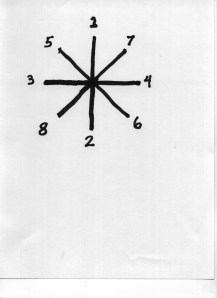
This is one of many escaping patterns, that practitioners practice. To understand how it works think of yourself as starting in the center of the octagon. You then move to each of the eight directions and back to center in order. You can continue the pattern as long as necessary.
Kosho folks always move twice. The first move is intended to put them at a 90 degree angle on their opponent, the second move can do the same, or be used to go through the opponent. For the purposes of escaping you would always be looking to end up 90 degrees on your opponent or possibly behind him. They always move twice because they assume there attacker will attack with all their weapons. Two arms means two punches. So for example the first move would be to position 1, and then move back to where they started. The next moves would be to position 2, then back to center, etc..
Now if you had an attacker start at position 7 or 4 and attacks you in the center, you could move to position 1 ( I used those two directions because moving to direction 1 would be appropriate only with the right combination of eye training and distance). Assuming the attacker continues his attack following you to where you move, you know where is is going to move one move before he does. This allows you too always escape, and end up at a 90 degree angle to your opponent. If he doesn’t follow you in the expected manor and you move, you’ll still just end up further away from each other. In this case neither of you would be harmed again.
If you determine that striking is necessary, by knowing where you’re opponent will move next. If you put your strike out on his line of travel, he will run into the strike adding his power, and momentum to your power on the strike. You will also catch him in transition this way, compounding the damage done.

Methods of Attacking
In reality, whether it is an army, an individual in a bar, or on the street. The most common, and most successful attack is the surprise attack. Let’s face it the hardest attack to defend is one you don’t know is coming. You need to understand that fighting is about winning and destroying your your enemy. You also want to reduce your chances of injury, or losing. Anyone that doesn’t have this mind set (or is at least aware of it), doesn’t survive long in the real world. If anyone thinks that cowboys actually went out in the street at high noon and faced off in a fair fight, they would be wrong.
Examples of armies using this approach would be the Japanese attack on Pearl Harbor, the US attacking Iraq. In the latter case even if a declaration of war happens first, you don’t warn the enemy where and when you’re going to attack them. Think of sentry removal techniques as part of an operation. You sneak up on, and kill the sentry before they know you’re their. I can’t think of any military operation in history where they didn’t try to use the element of surprise in their attack if it was possible.
The police certainly use the same approach when they go to arrest someone. Surprise, using overwhelming force are the only ways they attack people they are trying to arrest. I’ve never heard of any cop since the invention of the FBI, and J. Edgar Hoover who warned people, fought one-on- one, or used anything resembling a fair fight. At least not by choice.
Individuals using this approach would be said to sucker punch their opponent. While in many cases they just come up and strike, in other cases they come up from behind and attack, in other cases there is a verbal confrontation first. As a general rule in the last case once words have been exchanged, and one person thinks the issue is resolved (The other person wants them to think it is resolved). If one person makes the mistake of turning and taking their eyes off the other guy, before they have backed off out of reach, they are easily attacked. These attacks are extremely common. In my experience all of these attacks are far more common then two guys facing off after a verbal exchange, going outside and engaging in mutual combat.
Moral and ethical issues aside Martial Artists/ Martial Arts Schools don’t teach the above approaches for many reasons. First we are generally teaching civilians. Civilians are subject to the rule of law. Governments/ Current Societies don’t tolerate their citizens going around attacking each other. Win lose or draw, if you use the above approaches you could end up in jail and/or civil court with a lawsuit. I will say though, that anyone willing to engage you in a fight isn’t particularly concerned about the law at that point.
Sometimes people are warned before the attack, and have time to prepare. This is true of armies as well as individuals. With two armies, or two individuals lined up facing each other with all weapons ready, and out of each others reach, successful attacking with minimal risk can be a challenge. To attack you have to cross the distance between yourself, and your enemy. This puts you in transition, and makes you vulnerable.
If martial arts is about anything, it is about deception, and being able to predict your opponents reactions. With that in mind the first two things I want to talk about are fakes and feints.
A fake is something that you do, to make them think you’re doing something. Examples of this could be a head fake, to make them think your moving in a direction, it could be a look, or a sound. You are looking for a reaction from your opponent that you can capitalize on.
A feint is something you do that they must defend against. The idea with a feint is to attack a target that they have to move their defenses to protect against, which exposes another opening for you to attack. The feint doesn’t have to be particularly strong, it just has to make them defend. For example if I really wanted to hit them in the head I might feint at the legs or midsection. As they drop their hands to defend the feint, I hit my intended target. Their are many variations of this, both for individuals, and for armies.
Another benefit of using a fake or feint, is that it can tell you what your opponents subconscious tendency is for defense. If you can predict how your opponent will react to an attack, you can plan the right type of attack to be successful. This is especially helpful in sport competition.
For example if you throw a fake/feint a time or so, and every time your opponent charges you up the middle, or zig-zags to where you were, jamming/attacking you as his counter to your technique, it tells you how and where to hit him. In this instance you would throw the fake/feint and immediately step back at an angle to one side or the other, while throwing you real technique to the spot you just vacated, knowing your opponent is going to occupy it. He’ll run right into the technique, adding to your power.
If on the other hand every time you feint/fake he holds his ground looking to block and counter, your approach to attacking must be different. You don’t want to come straight up the middle because you’d be playing into his strength. Two methods of closing the gap would be to use an angular attack, or a broken rhythm attack.
Angular attacks are just that, you want to set him up so that your attack comes in from an angle, and you aren’t directly in front of him.
Broken rhythm attacks make use of timing, and syncopation. People all have two arms and two legs. So they move in a rhythm. One and Two, and One and Two, etc.. So the idea behind a broken rhythm attack is to set up a rhythm, and then catch them on the half beat with your attack.
Now if you notice that every time you throw a feint/fake your opponent backs off or runs away, you need a different approach. In this case you need to charge straight up the middle until you overwhelm them.
Another approach to minimize your risk, and improve your chances of success is to catch them in transition. Catching someone in transition is a very good method of closing the gap. Catching them in transition gives you a split second advantage during your attack where they have to adjust before they can counter. You can use any kind of transition.
For example if you are lined up in front of your opponent move to either the left or right a step. Your opponent will step to adjust, because they will feel uncomfortable not facing you. Move a few times and watch as they move to keep facing you. Then move again, and quickly attack while they are trying to adjust their position. They will need to finish setting before they can defend. this gives you an edge on your attack.
You can use virtually any kind of transition. You can use their breathing. Time it so when they exhale you attack. They will have to inhale first to move with power. You could use the blinking of their eye. I really like guys that bounce up an down, mimicking a boxer. As they bounce and are going up off their feet into the air, they can’t move until they come back down and their feet are on the ground. Any form of movement, including thoughts are transitions that can give you a split second before they can effectively defend.
There are other forms of attacks, but you can and should combine as many of the above methods of attack as you can. For example combing an angular attack with catching someone in transition is better then using just one or the other method.
Now here is my disclaimer I do not advocate attacking anyone for any reason other then in a sport competition following the established rules of that competition. With that said I think there is a lot to think about on the topic.
Conditioning and Resistance Training
Martial Arts practitioners, all have different opinions on this topic. However as a general rule. every teacher I’ve had, has said not to weight lift/Body Build. This includes external, as well as internal martial artists. Yet to a man they all do some form of resistance training.
I think the reason not to lift weights is that weight lifting/ Body building, focus on isolating muscles to develop maximum growth, and sculpt the body for appearances sake. This is not the best for functionality. What you need is for everything to work together in a synergistic manor. Not to mention that while body building you are constantly tearing down the body, and each time it recovers strength and coordination change a bit. I also noticed while lifting in this manor, while I felt a lot stronger, I was also a bit slower. You certainly need to spend more time stretching to keep from tightening up, or becoming muscle bound.
Of course being hard headed I’ve had to test this theory out myself in my youth. I used to weight lift/body build through High School. I went into the military after High School. My first duty station was Japan, where I learned judo. While in Japan I did very little weight training. Judo classes were two hours long. The first half hour was calisthenics, stretching, and break falls. The second half hour was Newaza (grappling techniques). This was basically paring off and wrestling, switching partners every so often. The second hour was all tachiwaza (standing techniques) we spent the first half hour doing uchikome (fitting in for practice throws, or working on a new throw). The last half hour was randori (free sparring standing). I believe I was in the best shape of my life then. On days not in class I ran3-5 miles, did my push-ups and sit-ups, and trained practice throws using a bicycle inner tube.
In 80 I PCS’d to Germany. I had been given a letter of introduction to Franz Fisher by the Kodokan, to help me go train there. Unfortunately I was stationed on a one acre site on a mountain top. I had a six mile walk to the bottom, where I could get a train to take into Frankfurt. So I spent a lot of time on the mountain lifting weights, and training with another guy that was a TKD Black Belt (we were teaching each other). Anyway after about a year, I managed to get to town to train. I thought I was going to be much better since I was a lot bigger, and stronger then before. Boy was I wrong. The warm-ups about killed me for a few weeks, then I was slow, stiff, and my timing was off. that took a few months to fix. Another guy in the class was also body building, and practicing karate. The instructor was always trying to talk him into giving up the weights, since he was displaying the same speed, timing issues, etc..
After I got back to the states I started training Judo twice a week with Charlie Hooks in northern Indiana, and training Juko Ryu Aiki Jujitsu with Randy Harvell six days a week. Randy had a full nautilus machine gym. We did circuit training three times a week, which did work well, and help our progress. We did high reps, and low sets.
Later I moved and learned/taught a couple different kempo systems. I tried to keep the same approach to conditioning, but if you couldn’t lift doing exercises like push-ups, and sit-ups, anything using your own body weight worked well.
When I started training the internal systems, I notice a different attitude about conditioning.
My first Internal instructor was Wai Lun Choi in Chicago. His approach to training was to do push-ups, sit-ups, leg-lifts, and stretching. The only weight training he did was to use a dumbbell, and he only did a few exercises which simulated things like throwing a hook punch. His belief was that you should only do exercises like this that developed power for a specific martial application.
My Next teacher was Jim McNeil. He also did push-ups, sit-ups, leg-lifts, hand conditioning exercises, and Shih Shui which you swing weights with. The beater that I have for use as part of your training weighs in at just under 5 pounds. Swinging that hundreds of times with each hand is a bit of exercise in itself. We also used to start each morning off with a 1-3 mile run depending on how folks felt that day.
I next started training Taijiquan. The Taiji folks leave me scratching my head the most on the subject of conditioning. They seem to be the most set against physical conditioning, out side of doing their basics, and forms. I was at a seminar, and a couple of us were stretching a little, one guy did a few push-ups before the class started. The Master running the seminar came up to us, and told us not to do that stuff, we should loosen up by only doing our jibengong. Now of course this group does do some resistance training with rubberbands/Bungee cords, but seem to not think of it as a conditioning exercise. The mind set seems to be against anything that isn’t taiji, because physical conditioning supposedly won’t help your taiji. While I can understand there is some truth to that on some level, purposely avoiding normal exercise doesn’t make sense to me.
Here are my reasons for that. First I think that the approach to not waste time on exercise, and devote your time to fundamentals, and your training worked very well up through the 1800’s. This is because people did manual labor all day. They were in great shape, and didn’t eat the junk food we get in the modern western world. For example the Chen villagers were farmers. I don’t know about you, but I grew up around farmers, and they were the strongest people I knew. Most of the people I see drawn to taiji today have desk jobs. The most exercise they get during the day is typing on a keyboard. So we’re certainly not talking about the same animal, as far as practitioners go.
Another reason I think you need some type of resistance training is that, as we age we lose muscle mass, and bone density. It becomes a bigger problem the older we get. The speed with which we lose muscle mass and bone density increases significantly over the age of 50. While losing muscle mass we tend to replace it with fat. So we might not really notice this slow process, as quickly as we should. As you loss muscle mass and replace it with fat, your metabolism slows down. You may stay about the same weight. This turns into a vicious downward spiral. So add some resistance training in, and some cardio. To me this is common sense.
I tend to change up what, and how I do things from time to time. Right now I’m using kettlebells a few times a week, along with a few push-ups, and hand conditioning. I want to slow down the deterioration as much, and as long as I can. I certainly don’t want to have a heart attack, shoveling snow, or pushing a car out of it, because I refused to take basic care of my health.
 Murphy Martial Arts